Thursday, February 22, 2007

Norman Mailer at Harvard

Now Mailer was often brusque himself, famous for that, but the architecture of his personality bore resemblance to some provincial cathedral which warring orders of the church might have designed separately over several centuries, the particular cathedral falling into the hands of one architect, then his enemy. (Mailer had not been married four times for nothing.) If he was on many an occasion brusque, he was also to himself at least so supersensitive to nuances of manner he sometimes suspected when in no modest mood Proust had lost a cell mate the day they were born in different bags. (Bag is of course used here to specify milieu and not the exceptional character of the mothers, Mme. Proust and Mrs. I. B. Mailer.) At any rate, boldness, attacks of shyness, rude assertion, and circumlocutions tortured as arthritic fingers working at lace, all took their turn with him, and these shuttlings of mood became the most pronounced in their resemblance to the banging and shunting of freight cars when he was with liberal academics.


I'll admit that part of me expected this 1967-fied, Armies of the Night Norman Mailer to show up at the First Church in Cambridge for the Harvard Book Store-sponsored leg of his latest book tour. That evaporated for a minute as the 84-year old writer hobbled to the stage on two canes. But even without a podium and a drink, Mailer was able to bring the feisty--while settled comfortably in an armchair, no less. It was difficult to hear him at first; the church, while beautiful and clean and open, had lousy acoustics for Old Man Voice with Crappy Microphone. But his voice got stronger as he got into the interview (the name of his interviewer escapes me right now, but it's his official biographer), and you could tell he still gets off on being the center of attention.

Just about all of the topics focused on his new book, The Castle in the Forest. Based on the given description of the book as a deeply imagined look at Hitler's early years, I'm not sure I'll pick it up--at one point, the interviewer mentioned that the first fifteen pages are essentially an SS officer talking about incest. Maybe I'll catch Mailer on the next novel. By the way: he mentioned that the book ends with a "To Be Continued?" First of all, risky game, tempting the calendar like that. Second, are real writers actually allowed to do that? Anyway, I'm not super keen on Hitlerian history, and it sounds like there's much Freudian stuff mixed in. So all WWII/mother obsessives, have at it, and let me know how it turns out.

When the floor opened up to questions, things took a much more current, political slant. I'm pretty sure "Don't you hate Bush?" has been a theme at 90% of the book events I've been to in the past year. But Mailer seemed game, and took whatever bait was thrown by offering opinions on the war, Hillary and Obama, etc. At one point he tried to goad the biographer guy into insulting him, just to generate God knows what kind of soundbite, but unfortunately the guy demurred. Probably out of respect or something. Lame. A Pulitzer winner asks you to insult him, you do it, dammit.

As Mailer is definitely an Endangered Author, I'm quite pleased to have gotten to listen to him while he's still in some kind of prime. It's not every day that you get to hear someone who's been fiercely literary, fiercely talented, and just plain fierce in his time.

Monday, February 05, 2007

Molly Ivins

This past week, there have been all sorts of tributes to Molly Ivins, who passed away after a long series of bouts with cancer. And while most of those tributes have been sincere and all, I'm not sure any of them really got to the heart of the Molly Ivins thing like Dahlia Lithwick's piece in Slate did. I guess it takes a smart, funny chick to properly eulogize another. (No offense, Paul Krugman.)

Of course, any tribute is better than the one Ms. Ivins got on a wacko-conservative message board that I like to read as a guilty amusement. Posters there made references to her rotting in hell with Ann Richards, and--my personal favorite--to the idea that if Molly Ivins had been "born beautiful," she would never have become an incisive writer and caused so much trouble.

Maybe that's true. Maybe with the right face and the right body, she would have developed a different kind of Texas woman's armor. But she wasn't the cheerleader type, and so we have her mourned well by another woman who "gets it."

Saturday, February 03, 2007

Housekeeping vs. The Dirt by Nick Hornby

I'm pretty sure Nick Hornby doesn't need to write novels anymore. He's already given us all the top-five lists and fucked-up relationships we could ever need. And with all his newfound free time, he can keep commenting on everything he reads. Sound good?

As a follow-up to The Polysyllabic Spree, the newest collection of his Believer columns, Housekeeping vs. The Dirt doesn't really vary much from that format. Not that it needs to. The essays are as engaging as ever, and they mix informal practicality and substantive reviews in ways that the New York Review of Books will unfortunately never touch. It's more like a friend talking about the books, being candid about what's boring, what's lame, and what's fun. Actual literary merit rarely matters over drinks. 'Course, it's not like I'll ditch pretentious/serious/jargony book reviews any time soon, but it's much more fun to get openly biased, tangent-filled picks or pans.

This is not to say, though, that the tone means that the essays are devoid of review-y philosophical goodness. Hornby makes a lot of interesting points in between his stories about how and where he bought the books, and discussions of his poor treatment at the hands of the Polysyllabic Spree of Believer editors. (Okay, so he touches on a lot of random thoughts I've had over the years but never really explored. Same diff.) Like, which books are "one of those books we've all read, whether we've read it or not (c.f. Animal Farm, 1984, Gulliver's Travels, and Lord of the Flies." And whether In Cold Blood is something you have to read to fit in with the literati (short answer: yes).

He also produces some nifty language to describe the depth of some books, in a way that's self-conscious, but can't really hide the glee he must have felt when the metaphor first popped into his head: "I have always prized the accessible over the obscure, but after reading Housekeeping I can see that in some ways the easy, accessible novel is working at a disadvantage (not that Housekeeping is inaccessible, but it is deep and dark and rich): it's possible to whiz through it without allowing it even to touch the sides, and a bit of side-touching has to happen if a book is going to be properly transformative. If you are so gripped by a book that you want to read it in the mythical single sitting, what chance has it got of making it all the way through the long march to your soul?"

And as usual, Hornby gave me a bunch of books to add to my queue. He's even managed to get me somewhat excited about reading novels again, after a lengthy hiatus. Not just anybody could make me break my current streak of nonfiction essay collections, but somehow he manages. I could probably acknowledge this favor by subscribing to Believer instead of waiting for the collections to come out, but it's more likely that I'll send the thanks toward one of my other favorite book reviewers for giving the well-chosen holiday gift of Hornby.

Saturday, January 27, 2007

Don't Get Too Comfortable by David Rakoff

You know how you meet someone, and you end up thinking he's a jerk after a few minutes of conversation, but he's friends with some of your friends, so you end up hanging out with him again anyway? That's pretty much how my reader/writer relationship has gone with David Rakoff. Most authors don't get a chance to re-engage me after severely disappointing me on the first go-round. (Just ask any number of chick lit and hipster writers.) But Rakoff did--mostly because I felt like I should like him. He's genuinely witty underneath the abrasiveness of Fraud (despite how obnoxious I found a lot of the writing); he's got the NPR hipster pedigree I usually love so well; and he's really entertaining when you see him on The Daily Show and the like. So I decided to pick up Don't Get Too Comfortable: The Indignities of Coach Class, the Torments of Low Thread Count, the Never-Ending Quest for Artisanal Olive Oil, and Other First World Problems.

The format is pretty much the same as Fraud's. Even the covers are nearly identical (I guess branding is a First World issue as well). It's another collection of nonfiction essays, most of which were first published elsewhere. But the writing is better, on the whole. Where Rakoff used to be too abrasive and judgmental about his subjects, now he's a little more contemplative, like he's learned more about profiling instead of condemning. And the latter must have been pretty tempting, given that George Bush, Hooters Girls, and Log Cabin Republicans are among the characters here. Rakoff is less likely to go for the instant scoffing payoff than he was before. The dry humor stays, without the shrill need to bond with the reader by saying "Oh my God, will you look at this guy?"

However, there are drawbacks to a deeper approach, in that Rakoff apparently feels it's necessary to end most of the essays on a moralizing note. Sometimes it works (as in a brief contemplation of the wonder of human travel at the end of a piece on contrasting airlines), and sometimes it just doesn't (like when an essay on working at the pool of a posh hotel finishes with a random musing on Floridian socioeconomics). It's like he's trying to give a journalistic overtone to what are very much fluff pieces. It's too bad, because the fluffiness is probably the best part. If you're gonna write about what happens to a person when he goes on a juice fast, great. I'd want to read that. Ditto on what it's like to work undercover as a poolboy. Explore, share, but don't bother pretending you're doing this for society's sake. I like Rakoff's curiosity about random things, and I'm coming around on his voice. I just wish those were the dominant elements here.

The highlights of the book include the aforementioned Log Cabin Republican piece, in which Rakoff tries to look objectively at how fellow gay men can align themselves with "the enemy;" a quasi-scientific profile of the cryogenic preservation movement, and all the related implications of mortality; and a reflection on the bureaucratic process involved in his becoming an American citizen. (Side note: the latter essay has a random appearance by Sarah Vowell as a character. Between this, the peer references in her own books, and Nick Hornby's shout-outs to her in his Believer columns, someone should be tracking this stuff. Clique lit is the new hotness, apparently. Too bad I'm too lazy and easily distracted by other projects to attempt such a chart on my own.)

And now for the usual Bits I Liked:

On a faded NYC billboard for a long-defunct strip club: "Nostalgia has always been a bit of a bunko scam. Authentic charms of its signage notwithstanding, it's worth remembering that those must have been pretty grim circumstances for the young ladies of the Whirly Girly. Unless it's your own heyday as a peepshow dancer you're fondly recalling, it's dangerous to drag a sepia-dipped brush over the sleaze of yesteryear."

On writing: "If seated at the computer, I check my email conservatively 30,000 times a day. When I am writing, I must have a snack, call a friend, or abuse myself every ten minutes. I used to think that this was nothing more than the difference between those things we do for love and those we do for money. But that can't be the whole story. I didn't always write for a living, and even back when it was my most fondly held dream to one day be able to do so, writing was always difficult. Writing is like pulling teeth. From my dick."

On leading the Log Cabin Republicans: "We go out to lunch together at a nearby Mexican restaurant. The only two people in the place on this gray day, we sit underneath strings of chili-pepper lights. It makes for a very sad fiesta. Perhaps abjection is in the air as I can't help wondering why someone would take a blowtorch to such a promising political resume. With the exception of that Jai Rodriguez fellow--the culture expert on Queer Eye for the Straight Guy--Patrick Guerriero might just have the worst gay job in America."

Monday, January 08, 2007

Character Studies Redux

P.S. A little research turns up the Ricky Jay piece ("Secrets of the Magus") and the Donald Trump essay ("Trump Solo"). They're long, but pretty entertaining. The Trump one is even better if you keep in your head the old SNL skit with Darrell Hammond playing Trump at a Domino's commercial shoot.

Sunday, January 07, 2007

Character Studies: Encounters with the Curiously Obsessed

Oh, Mark Singer, I really wanted to love Character Studies: Encounters with the Curiously Obsessed. I liked your "Talk of the Town" pieces on an amateur nudie photographer, and got caught up in the glamour of the New Yorker Festival that put your book on its convenience marketing table. Maybe the early headiness was too much. I expected too much from the relationship before it had a chance to blossom.

Oh, well. Mild disappointment aside, my issues probably aren't as much with Mr. Singer as they are with the problematic aspects of profile writing. In magazine format, it just comes across so much better. Maybe it's that the expectations are different: structure is rarely as important in a feature than it is in a book, where you know that you're investing a certain number of pages' worth of attention in any given chapter/story. So when the pieces are taken wholesale from a magazine as they are here, the transition feels bumpy. (I assume the pieces were left largely unaltered from the original appearances, although I find it difficult to believe that the New Yorker would run such long articles. This is untested, as I haven't yet caved in to buying the Complete New Yorker software to check these pieces, and apprently couldn't be bothered to drag my ass to a library that could help with such research.) The pieces feel rather rambly and unfocused--and for a book that promises obsessiveness in its title, that's not so much an asset.

However, Singer gets a gold star for effort. While some of the subjects are no-brainers (Martin Scorsese and Donald Trump, for example), others obviously took some roundabout thinking and random connection-making (like an upscale produce farming family in California, or a quirky book dealer in New York). Also to his credit, he pretty much allows the subjects to speak for themselves. He emerges periodically as an "I"--enough to establish voice--but never lets his perceptions color anything gleaned by the reader.

The pieces themselves are pretty uneven. A few are recommendably entertaining: the one about Trump basically lets him hang himself with his own blowhard noose. Another, about Martin Scorsese ("The Man Who Forgets Nothing") shows what a freak the man is. But in a good way, since said freakiness has given us Raging Bull, Goodfellas, and Casino. It makes him look like a lunatic, but an amiable one. It's also a little sad, though, because the timing of the piece frames Gangs of New York as the big push for lifetime achievement. After reading about his "process," it's easy to see how Mr. Scorsese would blame himself for losing out on the big prize--and that he's gone even more years without that piece of validation seems even worse. Maybe this year, Marty.

The chapter on the Japanese-American farm family in California, selling fancy eggplant and lettuces to Wolfgang Puck and roadside stand customers alike, is also interesting, but draws out the story way too long. Is it about these adult children who remain on the family farm, afraid to trust the family business to strangers? Is it about a family that survived the horrible US internment camps during WWII and went on to create something successful? Or is it about how an obsession with food quality is an art unto itself? Singer never really comes down in any quadrant that might focus and refine the story.

Same deal with a piece on Ricky Jay, a fascinating magician/performer/magic librarian whom I unfortunately only recognized due to his more pop-ish TV and movie work. At first it seems like a piece about a guy whose sleight of hand is so good that it seems uncannily real. Then it's a profile of someone whose art has been corrupted by the likes of David Copperfield. Then there's a lot of grousing about the nature of magic book collection. Lots of fantastic detail, but very little narrative to hold it all together.

Other pieces are just not as good, period. One, about a group who may or may not have stolen Pancho Villa's skull, I stopped reading about five pages in. There's also an extremely long one about a cult of Tom Mix obsessives. Maybe it would have been more interesting if I knew who the hell Tom Mix was--but I didn't, and not much effort was made to get me to care. The personal and descriptive details are cute, but not really grounded in much.

But the language is sharp, and that redeems several of the negatives. So while it'll be a long time before I pick up one of Singer's anthologized books again, I do look forward to reading his new stuff in my overmentioned favorite magazine.

Some fun bits from the book:

From "Trump Solo":
"As Dr. Ginger, out of earshot, manipulated the sore back of a grateful [Trump resort] member, I asked Trump where she had done her training. 'I'm not sure,' he said. 'Baywatch Medical School? Does that sound right? I'll tell you the truth. Once I saw Dr. Ginger's photograph, I didn't really need to look at her resume or anyone else's. Are you asking, 'Did we hire her because she'd trained at Mount Sinai for fifteen years?' The answer is no. And I'll tell you why: because by the time she's spent fifteen years at Mount Sinai, we don't want to look at her."

From "Secrets of the Magus":
"When he had performed several dazzling illusions and seemed ready to retire, a guest named Mort said, 'Come on, Ricky. Why don't you do something truly amazing?'
Baron recalls that at that moment 'the look in Ricky's eyes was, like, 'Mort--you have just fucked with the wrong person.'
Jay told Mort to name a card, any card. Mort said, 'The three of hearts.' After shuffling, Jay gripped the deck in the palm of his right hand and sprang it, cascading all fifty-two cards so that they traveled the length of the table and pelted an open wine bottle.
'OK, Mort, what was your card again?'
'The three of hearts.'
'Look inside the bottle.'
Mort discovered, curled inside the neck, the three of hearts. The party broke up immediately."

From "The Book Eater":
"The rest of the room was occupied by scores of unopened cartons of pamphlets, dating from the seventeenth to the twentieth century, which Zinman acquired almost four years ago from an ephemera dealer who had procured them, for the price of scrap, from the New York Public Library. This was material that the library had recorded on microfilm as part of a 'preservation' program that deemed the original documents expendable. In 1997 and 1998, Zinman--unable to resist the impulse to rub a great institution's nose in its ill-considered behavior--dispatched to friends, as well as to the library's trustees, poster-size holiday greeting cards devoted to the theme of the library's 'trashing' of its own collections."

Thursday, December 28, 2006

I Like You: Hospitality Under the Influence by Amy Sedaris

When I grow up, I don't want to be an astronaut or a ballerina. I want to be Amy Sedaris. She's charming, she's a little demented, and she's hilarious. So until the day I get those proportions right, I'll just have to settle for her recipes and tips on entertaining properly.

...Which, to be sure, are pretty entertaining. Not many people could get away with making a book half-parody and half-cookbook, but Ms. Sedaris manages it. The book itself is pretty simple: it's a series of tips, recipes, and short essays on entertaining. The practical stuff got a little repetitive, especially as I got further in the book and realized that I'll never actually throw the number of dinner parties it would take to use the full breadth of the Sedaris planning techniques. I think she realizes that, though, and moves from topics like shopping for a party to more exotic things like entertaining the infirm and cooking like a hobo. Possibly the most useful section is the one that discusses how to cook while under the influence. That alone is probably worth the cover price.

The "look" of the whole thing is very 1970s. When I was little, I loved looking through my mom's old cookbooks and stuff. It all seemed very elegant. Then time passed, and I realized that a) nothing in life ever, ever comes on a doily, and 2) food just isn't supposed to look like that. So now, in these days of photographs that make food look edible, and lighting that doesn't turn everything reddish brown, the old-school choice seems bold and artistic. Or something. The photos are hilarious, from the polyester dresses to the Betty Crocker stylized facial expressions and the general 1974 joie de vivre. Of course, since this is Amy Sedaris, said joie de vivre also includes a bong, crappy vegetable craft projects, and crying children.

But while the pictures keep everything afloat, the best parts are the random tips and observations. A few of my favorites:

"There is much one can do to remove a urine stain from a mattress. Vinegar can remove odors, but because this is a moisture problem, I suggest dragging your mattress out into the sun. But realize that you're not only airing a mattress, you're airing your dirty laundry as well."

Under "Children's Games": "Play Grown-Up. Have a cocktail party. Make fake liquor using food coloring....Pretend French fries with the tips dipped in ketchup are lit cigarettes. Have children simulate spousal abuse by arguing and, as this escalates, slapping each other. Use Tic Tacs to spit out of the mouth as if they were teeth. Use red Tic Tacs if you want to pretend they are bloody teeth. If there is an infant in the house, it's always fun to play Social Services. Have one child pretend he is going to take the baby away from another child. The pretend 'mother' can fight for custody....Have a child pretend he is walking in on his wife and catching her having an affair with another person."
[Editrix's note: Didn't every kid have scenarios like this when they played imaginary games? No? Just me? Okay then.]

On dating: "If you're the one leaving: Pack an overnight bag, you don't want to be seen walking the beltline in a Greek dress the next morning. Don't leave a piece of jewelry at his house so you can go back and get it later; he may be with his real girlfriend.

If he's the one staying: Pack the medicine chest. Trojans.

If you end up spending a lot of time in bed together with nothing to do, quiz each other on all the state capitals, then move on to learning 10 new vocabulary words a night. Good times. Frigid, incontinent, impudent, Clydesdale, vaginitis, homosexual, ennui, ampersand, charcuterie, abstinence."

So even though I will probably never have the swingin' parties that Amy is probably having right this second, it's clear that I have much to learn to get through life with a modicum of grace. And somehow I don't think I'll find it in any Martha Stewart magazine, so Hospitality Under the Influence it is, then.

Thursday, December 14, 2006

The Small Penis Rule

I do love a good literary slapfight. And this one's a doozy, if only because it involves petty references to penis size, one of the better magazines in the country, and a man who has sold more books than anybody but Jesus.

Columnist Accuses Crichton of 'Literary Hit and Run'

Choice excerpt:

Mick Crowley is described as a “wealthy, spoiled Yale graduate” with a small penis that nonetheless “caused significant tears to the toddler’s rectum.”

Mr. Crowley writes that Mr. Crichton’s Mick Crowley not only has a similar name but is also a graduate of Yale and a Washington political journalist. Mr. Crowley contends that Mr. Crichton has tried to escape public censure for his literary attack by hiding behind what has become known as “the small penis rule.”

The rule, Mr. Crowley writes, is described in a 1998 article in The New York Times in which the libel lawyer Leon Friedman said it is a trick used by authors who have defamed someone to discourage lawsuits. “No male is going to come forward and say, ‘That character with a very small penis — that’s me!’ ” Mr. Friedman explained.


This world would be so much more boring without the passive aggressiveness of writers. It's funny, 'cause an essay I just read for my Book Editing seminar talked about how a publisher pretty much has to rely on the dependability of an author to prevent legal issues like libel and plagiarism. Legal reads can only catch so much--and who's going to question Michael Crichton? Of course, I'm assuming this isn't provable libel, given that nobody really thinks Michael Crowley is a child molester, but it hews pretty close. I'm sure Mr. Crowley's penis would agree.

Saturday, November 04, 2006

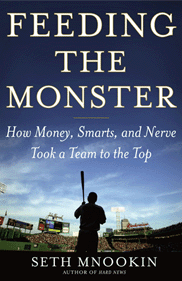
Feeding the Monster by Seth Mnookin

"The R.S. fans gave their undying loyalty. We will give our relentless effort, redoubled, next year. This loss in the ALCS only intensifies our resolve to win. We will be back."

This note, tantamount to a concession speech, was drafted by Red Sox co-owner Larry Lucchino in the eighth inning of Game 4 of the 2004 American League Championship Series. Everyone in Fenway Park and in front of a Fox TV screen at that point figured the Sox were going to collapse under an ego-bruising sweep by the Yankees. Next year. It's always next year. Only Lucchino didn't have to deliver his speech to legions of bitter and depressed Sox fans, 'cause we all know now that a stolen base and a crisis of Yankee confidence let the Red Sox go on to win the game, and the next three in a row. Then there was a World Series or something.

Moments like Lucchino's assumed capitulation are what makes Seth Mnookin's Feeding the Monster: How Money, Smarts, and Nerve Took a Team to the Top better than your average Red Sox book from your average native New England writer. Mnookin had an incredible level of access to team executives and players, and uses it to give a candid glimpse into the giant ball of dysfunction that is the Sox.

The book is definitely at its best when it covers the period between 2001 (when the current ownership team took over in a Boston-cum-Wonderland bidding process) and 2005 (when the team started devolving again into its usual self and almost sacrificed Theo Epstein in the process). The early-going parts, which describe the entire history of the team and the unrelenting bitterness tasted by the great players who never got to wear the ring, are nothing very special. The historical anecdotes about old owners and laughably bad Sox managers are entertaining, but they don't feel fresh at all. We get it--Boston's a crucible, the fans are crazy, and the players are usually misfits. Not new stuff. But all of it is necessary, if a bit long, because the book tries for reportorialism over easy partiality. Mnookin is mostly successful here; I can see a non-Sox fan enjoying the book. Nobody but people affiliated with the team takes much criticism, and there's no rubbing of faces in, say, total annihilation in the ALCS. (Seth Mnookin is a far better person than I.) But yeah...he explains a lot of the team's history, and bogs down the first half in the process.

Things don't really come alive until the last few days of the team sale in 2001, when a small cadre of low-level baseball owners are thrown together in a bid at the last minute and beat out the politically favored local investors to buy the team. There are even a few random Katie Couric cameos! Anyway, the new guys' bid wins, the Boston press grumbles, they hire the youngest General Manager in MLB history, the Boston press grumbles, the team starts winning consistently, the press grumbles less, the team trades Nomar, everybody grumbles more, and then they beat the Yankees and finally everyone's cool with everyone else. For about five minutes. Oh, well.

Mnookin is best at the sharp player profiles anyway. Many Sox players in the past five years get the burnish scraped off of them (except Ortiz, though that shouldn't be much of a surprise). Schilling, Manny, Millar, and especially Nomar take the biggest hits. I mean, I knew Nomar was pretty much a crying baby in his last few months with the team, but I didn't know how deep it ran. For example, before he was traded at the 2004 waiver deadline, a poll of Sox players revealed that nobody actually wanted him to stay. Perhaps this is because his agent is the devil, but I digress. The players are easily the most entertaining part of the book. Some of my favorite passages:

"One of this former managers nicknamed Schilling 'Red Light Curt' because of how he gravitated toward television cameras, and Phillies general manager Ed Wade, referring to a starting pitcher's workload of one game out of every five, once said that Schilling was 'a horse every fifth day and a horse's ass the other four.'"

"Early in the 2005 season, the following hand-written sign was tacked on a bulletin board in the Red Sox clubhouse: '1918 + 24 Manny + 34 Ortiz + 33 Varitek - 5 Nomar = 2004."

"In 2001, the Herald's Jeff Horrigan was doing an interview with Pedro Martinez for Sports Illustrated for Kids. Horrigan asked Martinez his favorite color. 'Green.' Favorite book? 'Whatever.' Favorite actress? 'Sandra Bullock.' Secret ambition? 'I would like to fuck Sandra Bullock,' Martinez replied with a grin. Horrigan explained that likely wasn't an appropriate response for a children's magazine and asked the question again. Martinez dutifully amended his answer: 'I would like to sleep with Sandra Bullock.'"

And some of the appeal of the book is just the simple baseball writing: "Of the four major North American professional sports leagues, Major League Baseball gives its fans the greatest illusion of intimacy with its players. Baseball's 162-game regular season is almost twice as long as basketball's and hockey's 82-game seasons, while football players suit up for a mere 16 non-playoff games a year. The rhythms of the game and the all-encompassing nature of its coverage help foster this sense of closeness between fans and players. When a pitcher steps off the mound with the bases loaded in the bottom of the ninth, you can watch as he takes a deep breath, screws up his courage, and enters back into the fray. Every player on the diamond spends much of every game standing on the field waiting for something to happen. These are the times in which he can be observed, times in which small quirks of his personality come through."

And finally, I learned some really important things:

* Larry Lucchino could disappear, and Boston would probably be better off.
* Globe columnist Dan Shaughnessy is an even bigger tool, on an even bigger power trip, than I thought. I have an idea for his next book: a treatise on what it's like to be banned from Fenway Park. Ideally the Sox will help him out by kicking him to the curb. Before spring training. Or next week. Whichever comes first.
* Theo Epstein is amazing even when he's cranky. It's too bad this job will kill him before he's forty.
* There is no cure for being a member of Red Sox Nation. Antibiotics might help when there's a flareup of irrationality, but the disease will never completely go away. Always practice safe baseball when interacting with other fans--relations with Yankee fans could be especially combustible, so be sure to refrain from (too much) trash talking.

So yeah. I laughed, I sniffled a little, I bought a copy for my dad. Good times all around.

Wednesday, October 25, 2006

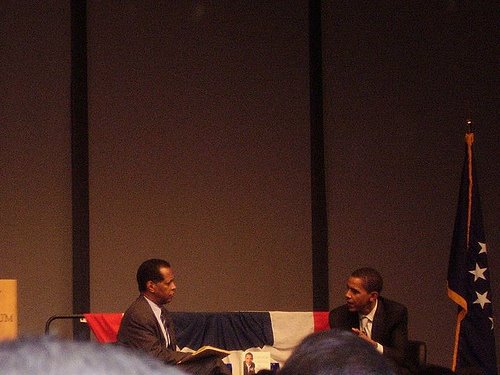
Obama forum at the JFK Library

[Note: if this looks familiar to the, uh, one person who reads this, it's because it's copied wholesale from my livejournal. I guess there are only so many times I can do half-assed recaps of a particular event.]

So I made the joke the other day that I'd probably walk out of the Obama event talking about how dreamy he was. And while I'm better in my old age at keeping the gushing crushes to a minimum, my geeky adoration for Senator Obama is still going full force.

Friday night, he was very much doing the charming politico thing. It's a pretty good mark of popularity when a guy can walk into a room of people who have been crammed into too-close folding chairs for well over an hour and a half, apologize for being late, and get a standing ovation for his efforts. Bob Herbert, the moderator for the forum, joked after his own introduction that he knew the crowd hadn't lined up for him--and sad as it is that people aren't clamoring for seats to hear a NY Times columnist speak, he was right.

Thankfully, they didn't mess around too much with soft questions, and Herbert asked the necessary ones with good humor. Overexposure? Obama agreed that even he's getting sick of seeing himself (though not as sick as his wife, apparently) on magazine covers, but that it's an honor, yada yada yada. Then there were questions about the current political climate, and Obama spoke passionately for a while about the midterm elections. He also put in a direct plug for Deval Patrick, the Democratic candidate for governor here in Massachusetts. I don't know if Political Operative Mike was there at the forum or not, but wherever he was, I'm sure he felt a warm shiver of joy down his spine at the moment of endorsement. Anyway, Obama was very emphatic about creating change via the elections in three weeks.

Then, before the lame audience questions started coming in, Herbert asked the big question, the one that everyone from Oprah to Tim Russert has been asking: will Obama run for president in 2008? For over a year now, the stock Obama answer has been something along the lines of, "I will serve out my Senate term," "I will not be running for president," etc. Not so much anymore. His answer this time was a rather long soundbite about how a person needs to be completely willing to sacrifice himself to the country to be President (with some witty jabs at the current president's vacation time, I might add), and that such a sacrifice can't be taken lightly. But he didn't say whether he had done this kind of thinking. And when Herbert pushed the issue, Obama answered that he's concentrating so fully on the next three political weeks that he can't even begin to think about the presidency. Which all just means that yes, unless something drastic happens, Obama will be in the field in '08--probably being hip-checked by Hillary and John Kerry.

As things wrapped up, the Kennedy Library rep made an unexpected announcement: Senator Obama would be signing books in the I.M. Pei atrium. Chance to meet Barack Obama? Yes, please. So I fought the crowds making their way, books in hand, down to said atrium. The line was long, but not so long that the outlook was discouraging. After about ten minutes, though, museum employees started working the line, telling people that the senator was on a tight schedule and would have to leave soon. Disappointing, but not so shocking--I assume there was some kind of fundraiser or other media event going on in Boston. But then the senator himself stood up to address the crowd; and instead of sneaking out under security cover like a lot of celebrities would have done, he announced that he was sorry he had to go. Then he proceeded to greet and shake hands with everyone standing in line. So the flyleaf of my copy of The Audacity of Hope is unfortunately still naked, but I totally got to shake his hand. And got eye contact and a "Hi, thanks for coming." Yup. Dreamy.

Anyway, I'm really glad I went, and tried so stubbornly to get tickets. I don't think I'll do the whole "JFK T stop after dark, by myself" thing again, but, y'know, that's something you can only learn by experience. Between this and Bob Woodward last week, I think I've done my good liberal duty for a while. Until Election Day, at least.